Roulette Wheel Calibration Standards Vary by European Region Affecting Realized House Edges in Casinos
Mia Krause · Jul 1, 2026
Roulette Wheel Calibration Standards Vary by European Region Affecting Realized House Edges in Casinos
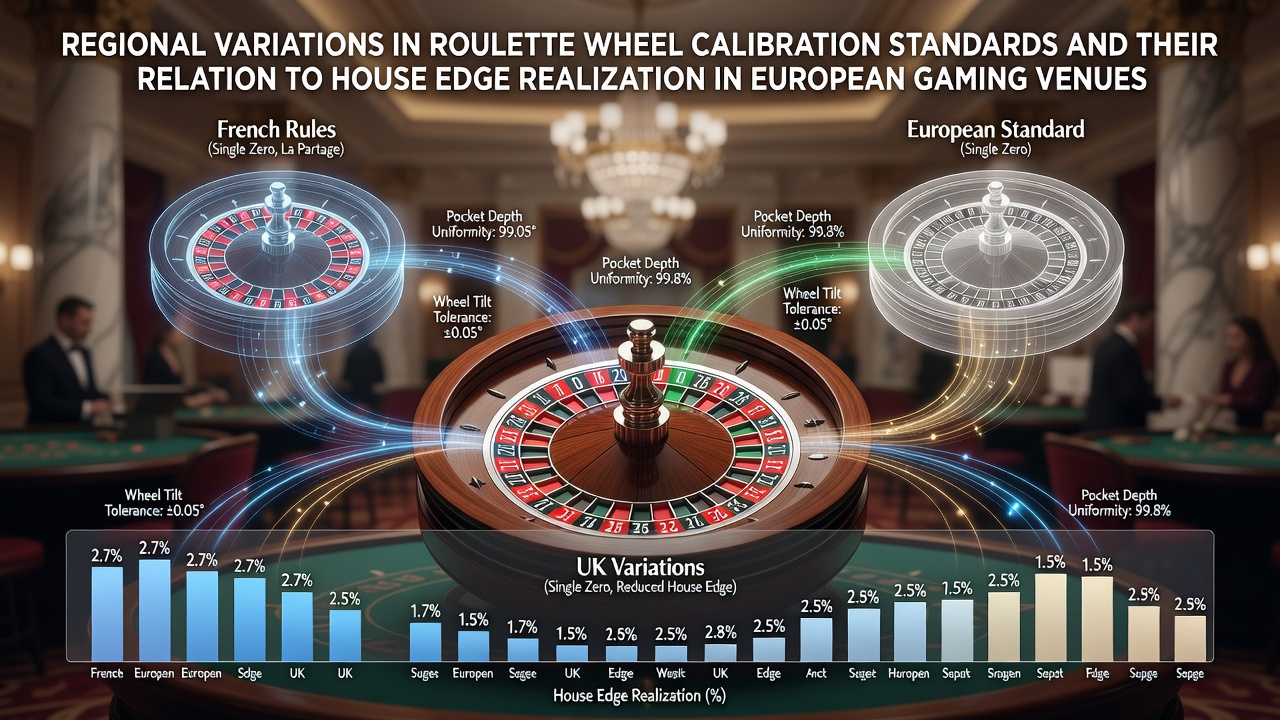
European roulette wheels operate under a framework where single-zero designs deliver a theoretical house edge of 2.7 percent, yet actual outcomes depend heavily on how each jurisdiction enforces calibration protocols. Calibration covers wheel leveling, pocket depth uniformity, rotor balance, and frets spacing, and inspectors apply these checks at intervals set by national or regional authorities. Data collected from multiple venues shows measurable differences in deviation rates once wheels leave the factory and enter daily service. France maintains strict requirements through its gaming control body, mandating monthly physical inspections that include laser leveling and electronic bias detection. Germany applies quarterly checks supplemented by continuous sensor monitoring in larger operations, while Italy relies on semi-annual audits combined with random spot tests. These schedules create distinct maintenance patterns across borders, and operators adjust their internal procedures accordingly to stay compliant.Calibration Protocols and Measurement Techniques
Technicians record rotor speed, pocket landing frequencies, and tilt angles during each inspection cycle. French standards require tilt tolerance below 0.05 degrees, whereas Italian guidelines allow up to 0.08 degrees before corrective action. German venues often integrate digital inclinometers that log data in real time and transmit alerts when readings exceed preset thresholds. Such variations mean wheels in one country may receive adjustments weeks before similar wheels in another jurisdiction reach the same deviation level.
Researchers tracking multi-venue datasets have documented how these timing differences influence short-term outcome distributions. Wheels that undergo more frequent recalibration tend to exhibit narrower deviation ranges in spin results, keeping realized returns closer to the theoretical 2.7 percent edge. Venues operating under longer intervals between checks sometimes record wider spreads before intervention occurs.
Impact on House Edge Realization Across Borders
Realized house edge refers to the actual percentage retained by the casino after thousands of spins rather than the mathematical expectation printed on the wheel. Calibration drift introduces small biases that players or the house may exploit over extended sessions. In July 2026 several operators across the Benelux region reported recalibration events that coincided with measurable shifts in daily hold percentages, confirming the link between maintenance timing and revenue outcomes.
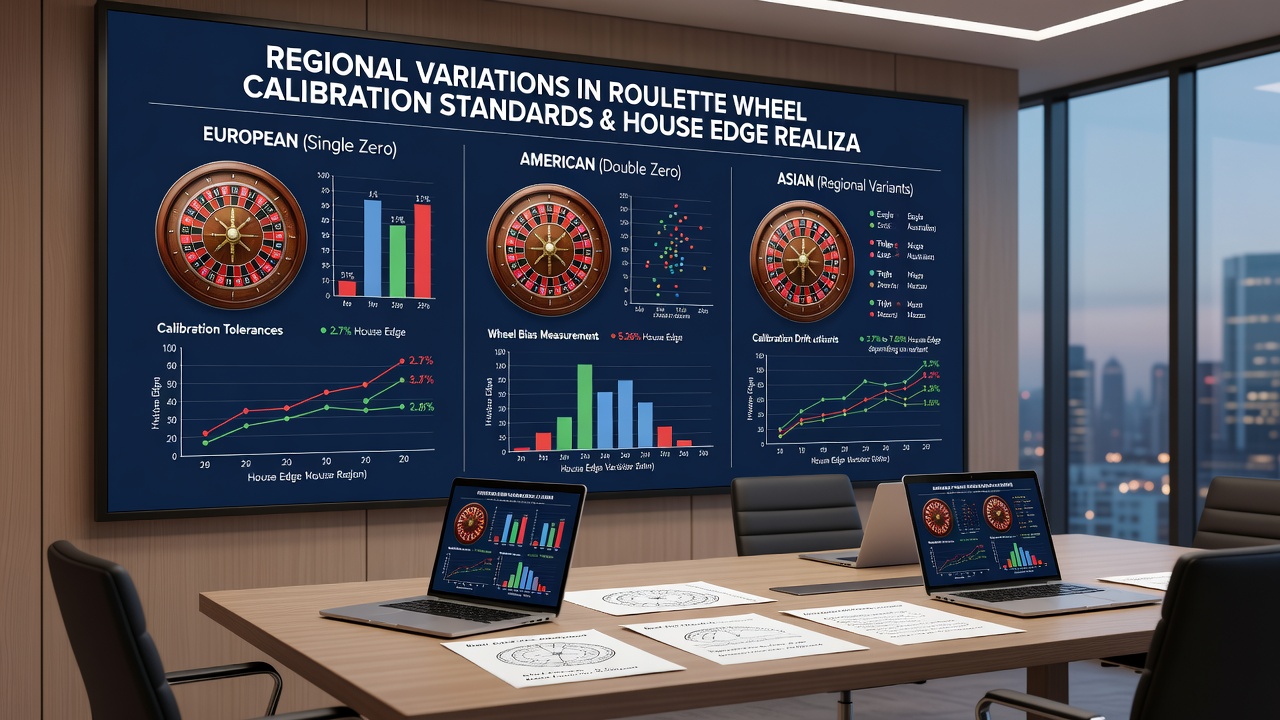
Cross-border comparisons reveal consistent patterns. Casinos in jurisdictions with tighter tilt and balance tolerances post realized edges within 0.1 percent of theory over 50,000-spin samples, while those allowing slightly wider tolerances see occasional spikes reaching 3.1 percent before adjustments restore equilibrium. These differences remain within regulatory limits yet affect daily reconciliation reports and long-term financial forecasting.
Regulatory Oversight and Industry Data Sources
The European Gaming and Betting Association compiles anonymized calibration statistics from member operators, highlighting how inspection frequency correlates with outcome variance. A separate academic analysis from the Technical University of Munich examined rotor wear patterns and found that wheels serviced under quarterly regimes accumulated measurable pocket-depth changes 18 percent faster than those checked monthly. Such findings supply operators with evidence-based schedules tailored to local rules rather than uniform European standards.
Spain's Directorate General for the Regulation of Gambling requires annual third-party verification in addition to internal checks, creating another layer of documentation that feeds into broader industry reports. These layered oversight systems generate the datasets used by analysts to map regional differences without violating individual casino confidentiality agreements.
Operational Adjustments in Gaming Venues
Venue managers respond to calibration findings by rotating wheels between tables, replacing rotors, or adjusting staffing during high-volume periods. Some properties install automated monitoring systems that flag deviations in advance of scheduled inspections, allowing preemptive maintenance that keeps realized edges stable. Others follow the minimum inspection cadence set by their licensing authority and accept the resulting variance ranges as part of normal operations.
Training programs for technical staff also differ by region. French and German curricula emphasize digital sensor interpretation, whereas Italian programs focus more on manual measurement techniques supplemented by electronic confirmation. These training distinctions reinforce the maintenance patterns already established by regulatory calendars.
Conclusion
Regional calibration standards continue to shape how closely European roulette outcomes track theoretical house edges. Differences in inspection frequency, tolerance thresholds, and measurement tools create measurable variations in realized percentages across France, Germany, Italy, Spain, and neighboring markets. Operators align internal procedures with local rules while monitoring data that links maintenance timing to revenue stability. As sensor technology and reporting requirements evolve, these regional distinctions remain central to understanding actual performance in European gaming venues.