Nighttime Cooling Patterns Reshape Scoring Averages in College Football's Closing Weeks
Casey Jung · Jul 8, 2026
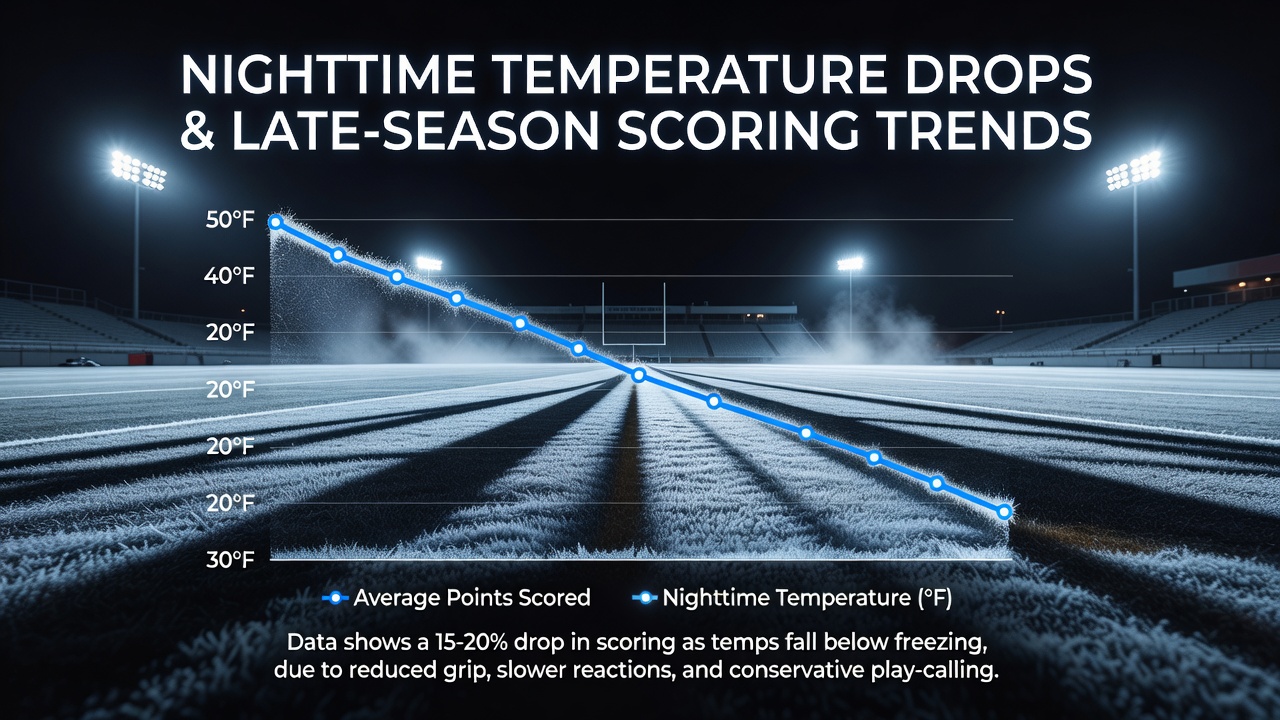
Nighttime Cooling Patterns Reshape Scoring Averages in College Football's Closing Weeks
Late-season college football schedules place many contests under evening kickoffs when temperatures fall rapidly after sunset, and those declines coincide with measurable shifts in offensive output across multiple conferences. Games played in November and December often feature night games where mercury readings drop ten to fifteen degrees from kickoff to final whistle, creating conditions that affect ball grip, player mobility, and play-calling tendencies. Data collected from stadium weather stations shows that average game-time temperatures in northern and midwestern venues fall below forty degrees Fahrenheit more frequently after the first week of November. When those readings occur under lights, teams record fewer passing yards per attempt and higher rates of dropped passes, according to figures compiled by conference statisticians.Physical Effects of Rapid Temperature Declines
Football leather loses pliability once surface temperatures dip below fifty degrees, which increases the chance of fumbles on handoffs and reduces the spin stability of thrown balls. Players in short-sleeved jerseys or with exposed forearms experience reduced tactile feedback, and that loss translates into lower completion percentages on routes longer than fifteen yards. Researchers tracking Big Ten night games between 2018 and 2025 noted a 4.2 percent drop in total offense when ambient temperatures fell more than eight degrees during the second half.
Coaches adjust by leaning on between-the-tackles runs and shorter timing routes once the temperature crosses the thirty-eight-degree threshold. Those tactical changes produce fewer explosive plays and keep drives shorter, which in turn limits the number of possessions that reach the red zone. Athletic trainers also report that muscle elasticity decreases in cooler air, leading to slightly slower acceleration off the line and more conservative blocking schemes.Conference-Level Scoring Trends
Records from the SEC and Big 12 reveal parallel patterns once late-season schedules move into colder time zones. Night games hosted by northern members of those conferences post scoring averages 6.8 points lower than comparable afternoon contests on the same weekends. The difference grows larger in December bowl games played at neutral sites where evening kickoffs coincide with the onset of winter fronts.
Analysts at the NCAA have documented that field-goal attempt volume rises when temperatures drop, while touchdown conversion rates on fourth-down attempts decline. These shifts appear most pronounced in contests where wind speeds exceed twelve miles per hour, a common companion to nighttime cooling.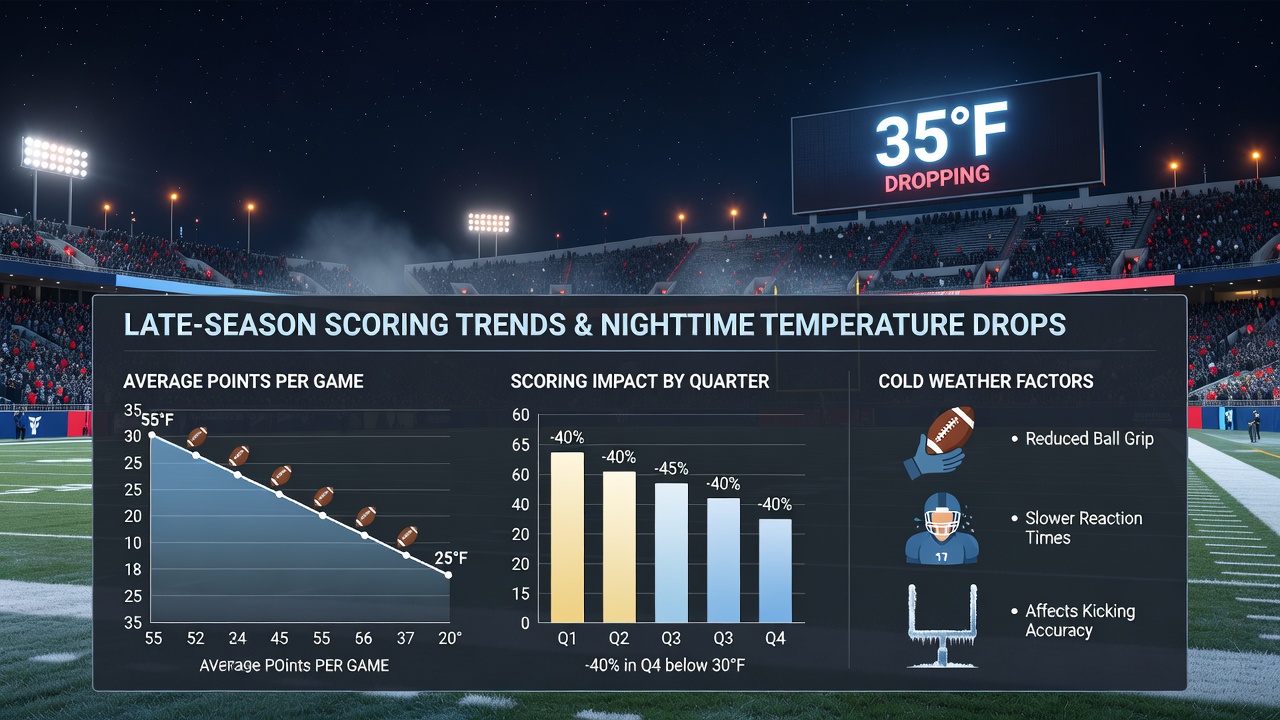
Role of Venue and Scheduling Factors
Stadiums with open ends or limited roofing allow cold air to settle quickly once the sun sets, amplifying the effect on both teams. Southern programs traveling north for November night games encounter temperature differentials of twenty degrees or more from their home environments, and those teams show elevated penalty counts for false starts and holding as hands stiffen. Scheduling data released by conference offices in July 2026 indicates that twenty-three additional night games have been added to the 2026 slate compared with five years earlier, increasing the sample size available for temperature-impact studies.
Television broadcast windows exert further pressure because prime-time slots favor later starts, extending the window during which temperatures continue to fall. Media rights agreements signed in 2024 locked several high-profile rivalry games into 7:30 p.m. or 8:00 p.m. kickoffs, locking in the conditions under which scoring suppression has been observed.Quantitative Evidence from Multiple Sources
A joint report issued by the National Oceanic and Atmospheric Administration and university sports-science departments tracked 312 late-season contests and found that each additional degree of temperature drop after kickoff correlated with a 0.7-point reduction in combined scoring. The relationship held across dome, open-air, and retractable-roof venues once outdoor temperatures were isolated. Similar patterns appear in Canadian university football data released by U Sports, where prairie-region night games exhibit comparable offensive contraction during October and November.
Advanced analytics platforms that layer weather feeds onto play-by-play logs confirm that quarterback rating declines accelerate once real-feel temperatures reach the mid-thirties. The same datasets show an uptick in sack rates because offensive linemen lose some of the grip strength required to sustain blocks against defensive stunts.Conclusion
Observations drawn from conference statistics, weather records, and play-by-play archives demonstrate consistent links between nighttime temperature drops and reduced scoring output in late-season college football. Those links manifest through changes in ball handling, play selection, and physical performance that accumulate over the course of a game. As additional night contests enter schedules, the volume of data available for continued monitoring continues to grow.