Exchange Rate Volatility Reshapes Stakes in Asia's Poker Tournaments
Mara Simmons · Aug 17, 2026

Exchange Rate Volatility Reshapes Stakes in Asia's Poker Tournaments
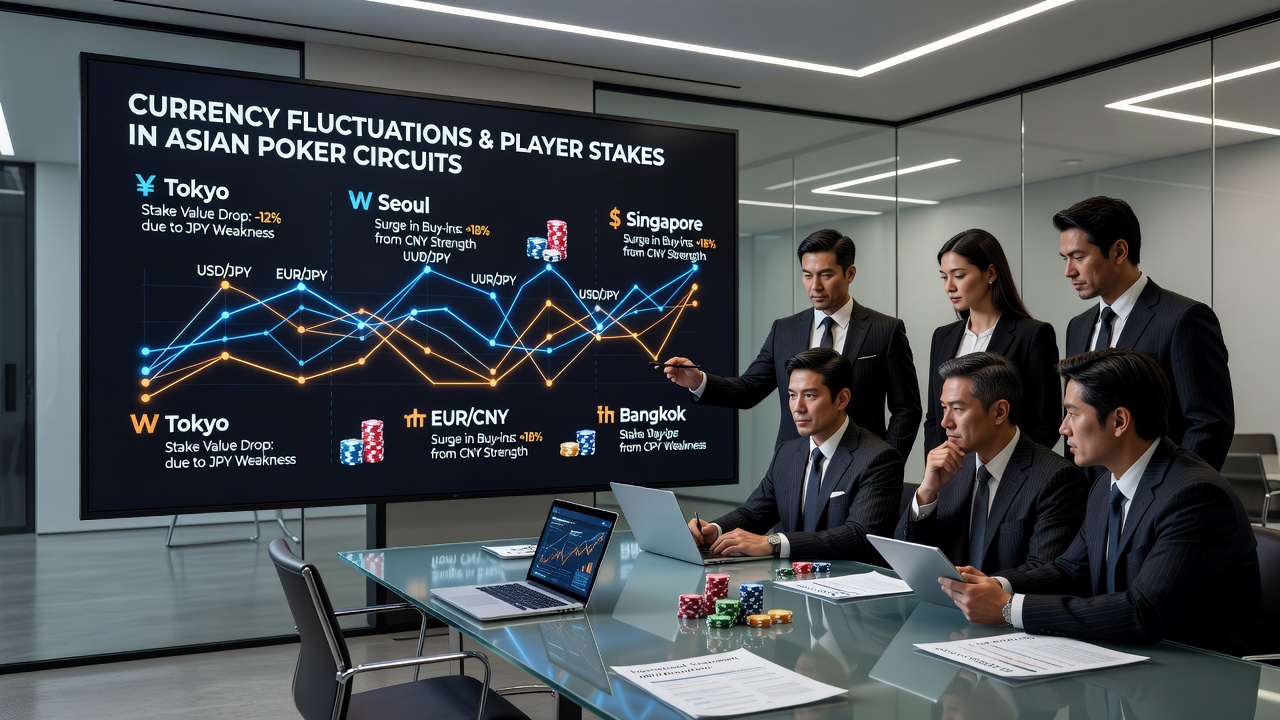
Currency movements have altered the real cost of participation for players across multiple Asian poker circuits, where organizers typically list buy-ins in US dollars while competitors convert funds from local currencies that swing against the greenback on a weekly basis. Data from regional banking records shows that between 2024 and 2026 the Philippine peso lost roughly 8 percent against the dollar, the Thai baht fluctuated within a 6 percent band, and the Malaysian ringgit recorded similar swings, each shift directly changing how much local players needed to set aside for the same nominal entry fee.
Buy-In Structures and Daily Conversion Realities
Most international series in Manila, Macau, and Bangkok continue to publish buy-ins in dollars because sponsors and prize pools rely on stable dollar accounting, yet players from surrounding nations calculate their outlay each morning using spot rates posted by local banks or exchange apps. Observers note that a $5,000 main event can require 15 percent more ringgit or baht on one day than it did two weeks earlier, forcing late adjustments to travel budgets and staking arrangements. Tournament directors report that last-minute withdrawals spike when a currency moves more than 3 percent in a single week, particularly among mid-stakes regulars who operate on tight margins.
Regional Player Pools React Differently
Professionals based in Singapore and Hong Kong, where currencies have remained relatively steady, experience fewer disruptions and often absorb small rate changes without altering their schedules, whereas participants traveling from Indonesia and Vietnam adjust more aggressively because their home currencies have shown larger deviations. Figures released by the Asia Pacific Poker Tour indicate that the proportion of entrants from Indonesia fell from 22 percent of the field in early 2025 to 17 percent by mid-2026 during periods when the rupiah weakened sharply, while Malaysian representation held steadier because ringgit movements stayed inside a narrower range. Staking syndicates that operate across borders now include clauses that tie repayment schedules to the exchange rate prevailing on the day of the tournament rather than the day the deal was struck.
August 2026 Tournament Adjustments
During the August 2026 stop of the Asian Poker League in Cebu, organizers recorded a 12 percent drop in early bird registrations from Thailand compared with the same month in 2025, coinciding with a sudden 4 percent depreciation of the baht that occurred in the final week before the series opened. Players who had already booked flights found themselves facing an effective increase of several hundred dollars once they converted remaining funds, prompting some to drop down to lower buy-in side events instead. Tournament staff responded by extending the registration window by 48 hours and accepting wire transfers at the rate locked on the day of receipt rather than the day of the event, a measure that partially offset the impact for those still on the fence.
Staking Markets and Hedging Practices
Third-party staking arrangements have incorporated forward contracts and rate locks more frequently, with groups that finance multiple players across circuits now requiring documentation of the conversion rate used at the time funds are advanced. Research compiled by academic teams at the National University of Singapore shows that players who hedge currency exposure maintain higher overall volume across a calendar year because they avoid sudden spikes in required capital. In contrast, those who convert only at the last moment report more frequent pauses in their schedules when rates move against them, particularly during monsoon-season volatility that tends to cluster between June and September.
Longer-Term Effects on Circuit Economics
Over multiple seasons the cumulative effect of repeated currency shifts appears in the composition of final tables and the distribution of prize money back into local economies. When a currency strengthens, players from that country bring home larger dollar amounts that convert into more local spending power, supporting secondary businesses around tournament venues. When it weakens, the same prize money buys fewer goods at home, which can reduce the incentive for repeat visits. Organizers have begun publishing historical rate charts alongside schedule announcements so that players can model potential scenarios before committing travel deposits.
Conclusion
Exchange rate movements continue to interact with fixed-dollar buy-in structures throughout Asia's poker circuits, producing measurable changes in participation rates and staking arrangements without altering the underlying tournament formats themselves. Data collected through 2026 demonstrates that circuits able to offer flexible payment timing and rate transparency retain broader regional fields, while those that maintain rigid cutoffs see sharper drops when local currencies move unfavorably. The pattern holds across multiple countries and series, reflecting the simple arithmetic of converting one currency into another on the day a player must pay.